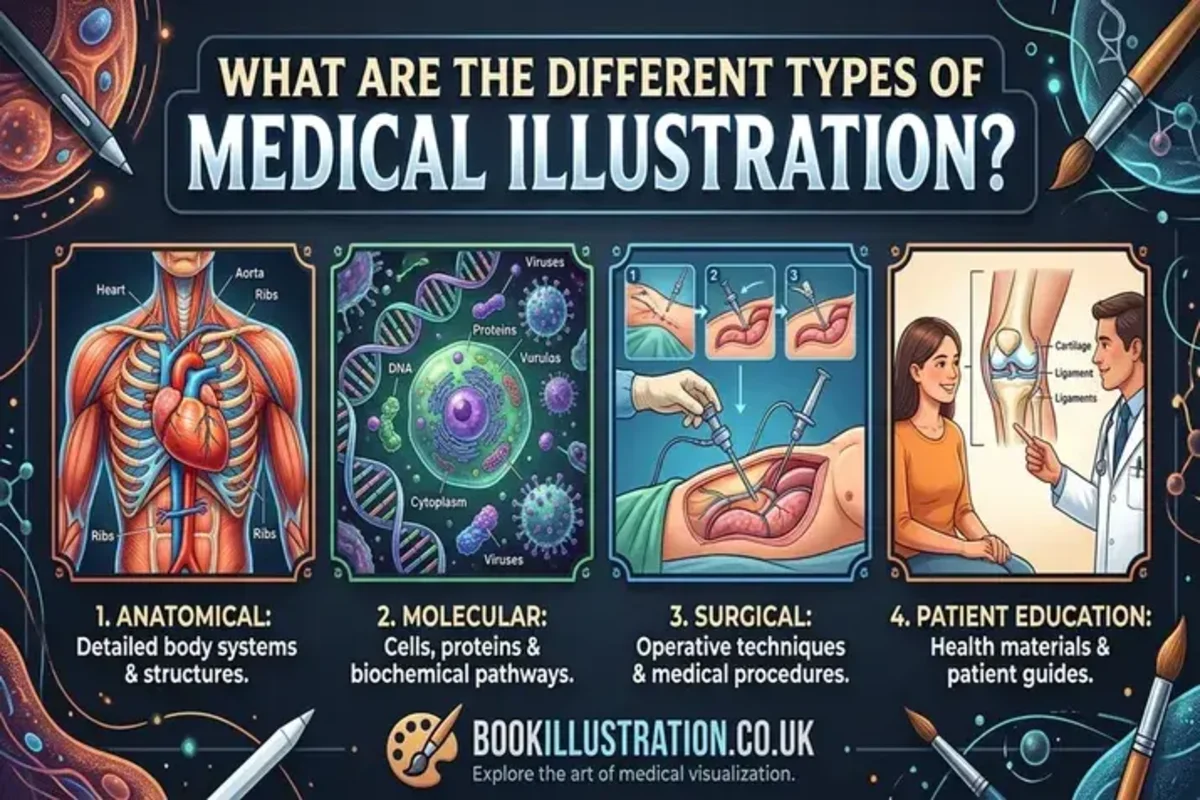
What Are the Different Types of Medical Illustration?
Say “medical illustration” to someone, and they’ll probably picture the anatomy poster in a doctor’s waiting room. But the job covers a lot more ground than that. You’ll find them in a cartoon on a leaflet about knee surgery, a drawing a lawyer holds up in front of a jury, or the single picture at the top of a research paper so busy people can grasp the point in five seconds. Different readers, different needs, and so different types. This blog covers the main types, what they look like, and what to check when a book needs illustrations.
What Is Medical Illustration?
It’s picture-making for subjects that don’t work well as plain text. Try explaining how the bile duct tucks in behind the liver using only words. Most people would need a second read and still wouldn’t be sure. One drawing fixes that.
None of this is new. Berengario da Carpi gets named as one of the first anatomists to put illustrations in a textbook, and Frank Netter’s atlases are still part of medical education today. The people doing the work now often have a master’s in medical illustration, so they’ve sat through anatomy, embryology, and pathology classes on top of art, which is really the main point. A lovely drawing with a nerve running the wrong way isn’t a small slip. Readers trust pictures, and that trust is easy to break by accident.
What are the Main Types of Medical Illustration?
Sorting by purpose works best, because purpose tells you who’s going to be looking.
| Type of Medical Illustration | Mainly Used For | Typical Audience | Common Examples |
| Anatomical | Showing body structures | Students, doctors | Bones, muscles, organs, blood vessels |
| Surgical | Explaining procedures | Surgeons, clinicians | Operation steps, surgical techniques |
| Patient Education | Making medical information easier to understand | Patients, families | Surgery leaflets, treatment guides, clinic posters |
| Medical-Legal | Explaining injuries or medical events | Lawyers, judges, juries | Injury diagrams, surgical error visuals |
| Editorial | Explaining or attracting attention to health topics | General readers | Magazine artwork, health articles |
| Graphical Abstracts | Summarising research | Researchers, academics | Study findings, research processes |
Although the categories may show some overlap, when it comes to the target audience, it usually offers the key, like a surgeon who needs a different image from a patient in the clinic, even if they look at the same medical subject.
Anatomical Illustration
Anatomical illustration means one that shows bones, muscles, organs, blood vessels, and even systems of an organism. They are used for teaching purposes and appear in examinations. The audience of such illustrations is very critical and does not tolerate any mistakes regarding labels.
Surgical Illustration
Although an operation can be filmed, the video will show only the outside of the body. An illustration can show what happens under the skin. The surgical illustration can demonstrate every stage of surgery, from the beginning of the operation to the end. Before the publication of surgical illustrations in a journal, a surgeon has to approve them. The audience consists of other doctors, so it is important for each part of the operation to be understandable even for somebody who has opened the book in the middle.
Patient Education Illustration
Picture somebody who’s just been told they need a kidney transplant. Now, they’re worried. Material for them uses big simple shapes, calm colours, and almost no jargon, and it ends up in leaflets, consent forms, and clinic posters.
Medical-Legal Illustration
A jury has to understand a spinal injury or a surgical error without any medical training, and the other side’s lawyers will go looking for weak spots. So the drawing has to stay neutral and accurate. Some studios build animations for this, which can show how an injury happened.
Editorial Illustration
The magazines and healthcare websites are looking for something that stops viewers from continuing to scroll. Therefore, artists have more freedom in their expressions. For example, inflammation can be represented using the metaphor of a fire in a joint as long as the meaning of the metaphor is supported by the scientific aspect. The same applies to graphical abstracts, which allow a whole study to be summarised in one image.
What Styles Do Medical Illustrators Work In?
Type is about purpose. Style is simply how the thing looks, and one subject can be drawn in a few different ways.
For medical anatomy drawings in textbooks and journals, line art is the usual choice. Black and white prints are affordable and easy to read. Full colour brings in shading and texture, which atlases make good use of. Watercolour turns up in editorial work when something softer is wanted. 3D models also run animations, and demand has grown alongside VR in medicine. Infographics handle data, for the times a table of numbers needs to become something a reader can take in at a glance.
A printed atlas and a phone app won’t want the same style. A waiting room poster is a third thing again.
How Do You Find the Best Book Illustration Service for a Medical Title?
Say a small publisher is putting together a nursing textbook with sixty figures. Picking the wrong studio would hurt, so a few questions are worth asking before any money moves.
Training comes first. Anyone can draw an attractive heart, but drawing a correct one takes real anatomy knowledge, so a science background or a medical illustration degree is a good sign. Then there’s the portfolio. Somebody with a lovely children’s book history might struggle with a surgical atlas, so samples close to the project matter more than a glossy general portfolio.
Money and rights get skipped far too often. The Association of Medical Illustrators points out there’s no standard price, since it depends on how complex the content is, what reproduction rights are wanted, and how experienced the illustrator is. Get it in writing whether print, ebook, and future editions are all covered. Ask about revisions too, because medical content usually goes through expert review, and a studio with feedback rounds saves a lot of back and forth.
One more thing is consistency. Try to give all the work of the same project to one artist, even if it’s sixty drawings. Somebody who is experienced will easily know if multiple artists worked on it.
For a simple diagram, a freelance marketplace may do the job. Detailed anatomy usually needs a specialist, so finding the best book illustration service for the subject matters.
FAQs
Is medical illustration expensive?
It can be, but there’s no one price that fits every project. A small diagram is obviously different from a detailed anatomical plate or a 3D animation. The amount of work and the rights you need will both make a difference.
What are the main types of medical illustration?
There are anatomical illustration, surgical illustration, patient education work, medical-legal illustration, and editorial work. Graphical abstracts are another one you’ll see in research.
What does a medical illustrator do?
A medical illustrator takes something difficult to explain and puts it into a picture. That could be an organ, a disease, or a procedure. Sometimes one good drawing does the job of a whole paragraph.
What are they used for?
They show an operation in pictures. An illustrator can show the first incision, the structures underneath, and what happens next. That’s sometimes much clearer than trying to explain the whole thing in photographs.
Bottom Line
Medical illustrations typically refer to various forms of work in the fields of surgery, law, education, and publishing, with different styles being applied depending on the type of illustration. Learning the exact type of medical photo desired will help simplify the writing of the artist’s brief.

I am Alex Morgan, a passionate graphic illustrator and creative storyteller who blends visual art with insightful blogging. Through detailed illustrations, design inspiration, and creative industry tips, I help readers explore the world of digital creativity. My blog covers art trends, branding ideas, and practical guidance for aspiring designers and visual content creators.