
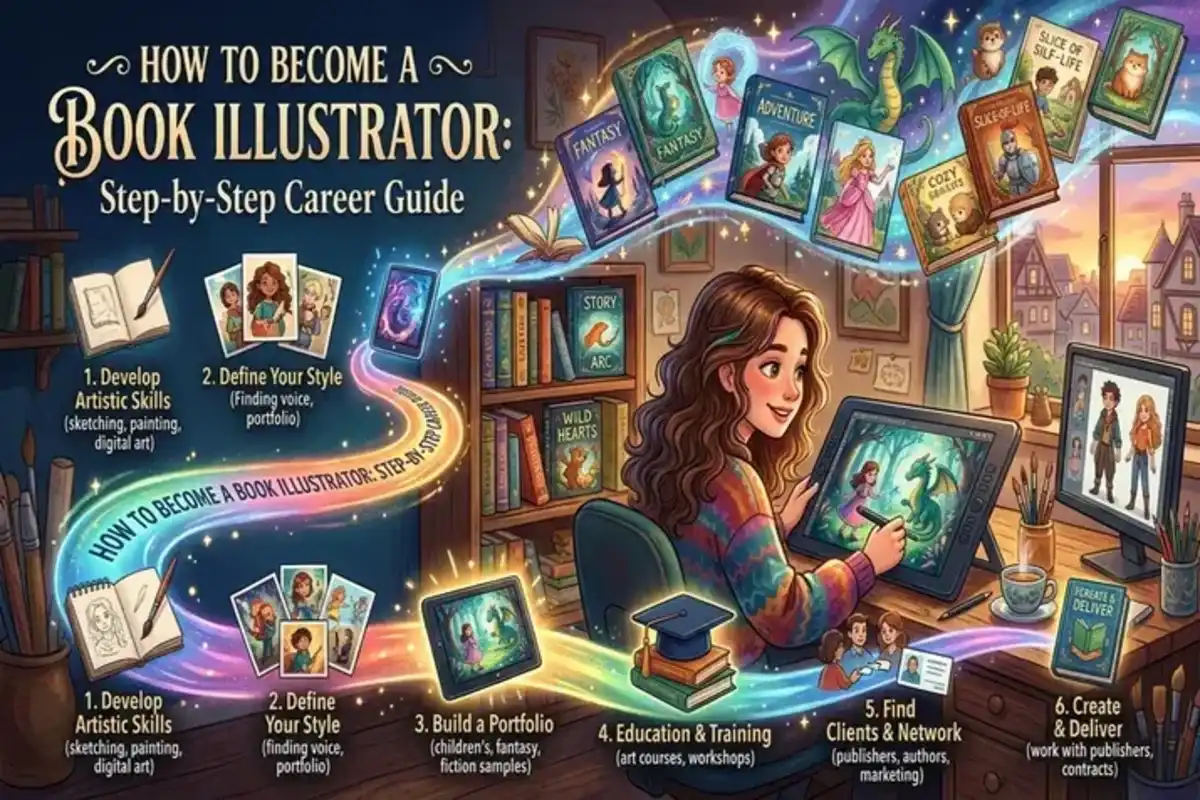
How to Become a Book Illustrator: Step-by-Step Career Guide
Becoming a book illustrator comes down to three things: solid art fundamentals, a portfolio built specifically for publishing, and knowing where to put that work in front of the right people. There’s no single entry point, no required degree, and no one path that works for everyone in this field.
What separates illustrators who get hired from those who don’t usually isn’t raw talent. It’s how clearly their portfolio shows they understand the job and how consistently they pitch it to people who can actually say yes.
What Is Book Illustration?
Book illustration is the process of creating images that work alongside a text, or in place of it, to help tell a story. Interior illustrators build the visual world of a book: characters, settings, and key scenes that match the pacing of the text page by page. In a picture book, that might mean an image on every spread. In a middle-grade or YA novel, it could be a handful of chapter-opener pieces or none at all beyond the cover.
The work is briefed by an author or publisher, so an illustrator is interpreting someone else’s story, not inventing their own. Book illustration sits at the intersection of drawing skill and reading comprehension: you’re translating text into something a reader sees before they read a single word.
Where Book Covers Fit In
Cover art is a separate job from interior illustration, even when the same artist does both. A cover has one task: make someone stop scrolling or pick the book off a shelf, all in a single image. It has to work as a thumbnail, communicate genre and tone instantly, and still hold up printed large on a physical book.
Interior art supports a story you’re already reading. A cover sells the story before you’ve read a word of it. This is especially true for children’s book covers, where colour, character expression, and a clear focal point do most of the work in catching a young reader’s attention.
Develop Your Core Illustration Skills First
Before anything else, you need to ensure that your core skills are solid enough even without publication. This is where all illustrators begin – be it those who attended art school or those who have learned everything on their own.
Key things to focus on include:
• Drawing basics: proportions, perspective, and anatomy, namely hands, faces and motion
• Composition: arrangement of the scene, which will determine where the reader’s gaze goes
• Color theory: use of colors to create atmosphere and draw the reader’s eye
• Digital skills: being proficient in Photoshop, Procreate, or Illustrator, which is basically where all published works go through
Learning Design might accelerate this process but is not essential. Many illustrators have learned everything through practice, classes on the Internet, and constant feedback instead.
Pick a Style You Can Call Your Own
Different age groups need different visual approaches, and it helps to know which one you’re aiming for. Picture books lean bright and expressive, built for read-aloud pacing. Middle-grade work is often simpler and more graphic, while YA and cover illustration tend to favour mood and atmosphere over cuteness.
Instead of chasing whatever style is trending online, spend time figuring out what you naturally draw well and enjoy drawing. That consistency is what publishers notice first. A recognisable style tells an art director exactly what they’re getting before they read your bio, and it’s what makes your work memorable enough to call back for a second project, whether that’s interior pages or children’s book covers.
What Should Your Portfolio Include?
Your portfolio speaks even before you do. Make sure that it consists of only your 10-15 best works, which are especially designed for the book publishing industry and not a compilation of some unrelated design projects. If you have not gotten the job, your self-initiated works will be equally effective as your commercial projects.
What to include and why:
| Piece Type | What It Shows |
| Character sheets | Consistency across poses and expressions |
| Full-spread scenes | Storytelling and pacing across a page |
| Sample book covers | Genre awareness and commercial instinct |
| Action or interaction shots | Movement, not static, posed figures |
Quantity is less important than quality. It is better to submit an organized selection of pieces that demonstrate range rather than a huge number of pieces.
What Can You Realistically Charge?
Rates vary based on experience, style complexity, and how many illustrations a project needs.
Per Page
Common for full-length books with an illustration on every spread, usually running $60 to $200 per page depending on detail and revision rounds included.
Per Illustration
Useful when a book only needs select images rather than art on every page, typically priced between $120 and $500 per piece.
Flat Project Fee
A negotiated lump sum covering the entire book, often landing between $2,500 and $8,000 for a full picture book with interior art and cover combined. It’s predictable for both sides, but timelines matter: a full picture book typically takes two to six months, and income builds slowly as you take on more projects.
Where Can You Find Clients Locally?
Finding work comes down to putting your portfolio in front of the right people, consistently.
- SCBWI: the Society of Children’s Book Writers and Illustrators runs networking events and critique groups where illustrators get feedback and meet working professionals.
- Reedsy: connects illustrators directly with self-publishing authors looking for interior art or cover work, outside the traditional publisher route.
- Direct submissions: many publishers accept portfolio submissions straight from illustrators, though some list local illustrators only, so it’s worth checking submission pages before reaching out.
- Cold outreach: a short, direct email to an art director with a portfolio link still works, especially when it’s tailored to their list rather than sent in bulk.
FAQs
Do book illustrators need a degree?
No. Portfolio quality and drawing skill matter far more to publishers and clients than a formal degree. Many working illustrators are self-taught through practice, online courses, and consistent feedback.
What software do book illustrators use?
Procreate and Adobe Photoshop are the most common tools for painting and detailed artwork, while Adobe Illustrator is used for vector-based styles. Clip Studio Paint is popular for clean line art and character work.
Are children’s book illustrators in demand?
Yes, though the field is competitive. Growth in self-publishing has created more direct-hire opportunities, alongside steady demand from traditional publishers for both digital and hand-drawn styles.
What skills does a book illustrator need?
A mix of core art skills like drawing, composition, and colour theory, along with digital software fluency and business skills such as client communication and meeting deadlines.
How much does a book illustrator get paid?
Pay varies widely by project and experience. Freelance illustrators often charge per page, per illustration, or a flat project fee, while traditionally published illustrators may receive an advance plus a small royalty percentage on sales.
How Do Illustrators Actually Build a Career?
Becoming a book illustrator isn’t about one big break. It’s built through consistent practice, a portfolio that keeps improving, and pitches sent even when you don’t hear back right away. Most illustrators who build a steady career got there by staying visible and adjusting their work based on real feedback, not by waiting for the perfect opportunity.
Treat each project, paid or self-initiated, as another piece of proof for your next pitch. The skills you build early carry into every stage of this career, and the effort you put in now is what makes the next opportunity easier to land.

I am Alex Morgan, a passionate graphic illustrator and creative storyteller who blends visual art with insightful blogging. Through detailed illustrations, design inspiration, and creative industry tips, I help readers explore the world of digital creativity. My blog covers art trends, branding ideas, and practical guidance for aspiring designers and visual content creators.